Tuesday, December 11, 2012

I do. Or I would if you'd let me.


Lindsay Harkins
English 125


I do. Or I would if you'd let me.

            I grew up in a small mostly white conservative town where being different was not accepted. I had a friend who came out in eighth grade. I didn’t care, he was still the same guy, he just liked guys. But a lot of the other kids were disgusted. They didn’t even know him and he was a common topic of conversation, because he was different.
Our freshman year of high school he brought his boyfriend to the homecoming dance. We all hung out on the outside of the crowd, dancing and having a good time. A slow song came on and my friend was dancing with his boyfriend. Word got around about it and people started “casually” walking by to get a look. A gay person in Brighton was just unheard of. Soon people started taking pictures and standing there and yelling at them. My friend paid no attention to them, but myself and the rest of my friends were disgusted. We went and stood between the crowd and our friend, told them to go away. They kept yelling at us about how it was disgusting and they shouldn’t have to see it, but soon they got bored and went away. To this day I can not understand why it was so disgusting to them that he was gay.
Pictured: Another example of the hate gay people receive on a regular basis. [1] 
            I suppose that is what comes of growing up in a town with no diversity. We never really learned how to deal with it. Even so, I didn’t see why we should be rude to someone because of their race of even their sexuality. I still don’t understand why we do this. Why should people not be allowed to marry simply because they are gay?
            Dr. Martin Luther King went through similar discrimination. He was not allowed certain rights because he was black. For this reason King was always a proponent of equality. He explains that a law is just if it promotes equality. In his “Letter from Birmingham Jail” he explains,
An unjust law is a code that a majority inflicts on a minority that is not binding on itself. This is difference made legal. On the other hand, a just law is a code that a majority compels a minority to follow, and that it is willing to follow itself. This is sameness made legal.[2]
King is flat-out telling us that if not everyone has to follow a law, then it is unjust. By this, you could say that if not everyone is banned from marriage, it is unjust. Here justice calls for equality, which means everyone having the same marriage rights.
Pictured: People protesting gay marriage. [3]
            Some people would argue that legalizing gay marriage would weaken the institution of marriage. To them, marriage is a coveted rite of passage that should not be sullied by sin, and they believe that being gay is a sin.  They use verses from the Bible to back up their claims. The most well known is Leviticus 20:13, “If a man lies with a man as one lies with a woman, both of them have done what is detestable. They must be put to death; their blood will be on their own heads”[4]. Opponents of gay marriage would use this verse to show why they believe being gay is a sin, and because they think it is a sin, they don’t want to legalize it and allow it to taint the institution of marriage.       
            This is a very hypocritical stance. The Bible also says not to wear clothing of mixed fabric[5] and it’s pretty hard to find clothes today that aren’t a veritable blend of this or that. Even one of the ten commandments, “You shall not misuse the name of the Lord your God, for the Lord will not hold anyone guiltless who misuses his name,”[6], is broken often by anyone who utters the phrase “Oh my God”. Everyone sins! What makes the so-called sin of homosexuality any greater than other sins? Why should their sin deny them the privilege of marriage that other sinners get to enjoy?         
            Dr. King talked of the “moral law of God”, and how a law is unjust if it does not align with the moral law. He states that, “All segregation statutes are unjust because segregation distorts the soul and damages the personality”[7]. And didn’t God tell us to love one another? Here, it seems that the moral law of God is calling for equality. Dr. King was a clergyman, but even so, equality was the most important thing in his eyes; it’s what his entire fight was based on.
Pictured: Senator Baldwin on the eve of her election. [8]
           We are making strides. In the recent election the first openly gay senator was elected  of and Maine and Maryland voted to legalize gay marriage. They are the seventh and eighth states to legalize it, but more importantly the first to ratify by statewide vote rather than legislation. Chad Griffin of the Human Rights Campaign, a national gay-rights group, was quoted saying, “For the first time, voters in Maine and Maryland voted to allow loving couples to make lifelong commitments through marriage…”[9]
           However, it isn’t quite enough. Everyone deserves to have the right to marry whomever he or she loves. That is why gay marriage should be legalized on a national level.  Perhaps something along the lines of Maine’s LD 1020, which repealed an earlier provision that prohibited same-sex marriage[10]. Dr. King said, “…time is neutral. It can be used either destructively or constructively”[11]. He means that we can’t sit around and wait for legislation to come; that would be using time in a destructive way. We have to work for national legislation. Be constructive! Always move forward!

[1]     Jamie C. Baker, The Sanity of a Mad Woman, accessed December 3, 2012, http://www.google.com/imgresq=discrimination+against+gays&num=10&hl=en&tbo=d&authuser=0&biw=1134&bih=573&tbm=isch&tbnid=ageQVKPJOCJguM:&imgrefurl=http://cutelypoisoned.com/tag/gaymarriage/&docid=z94PZlUJxdNRYM&imgurl=http://cutelypoisoned.files.wordpress.com/2012/10/gay_marriage_opponents1731273.jpg&w=314&h=310&ei=GknHUNzFAsLu2gWX4oHgAg&zoom=1&iact=hc&vpx=176&vpy=76&dur=577&hovh=156&hovw=165&tx=150&ty=104&sig=114598067277195484699&sqi=2&page=1&tbnh=153&tbnw=162&start=0&ndsp=20&ved=1t:429,r:1,s:0,i:86

[2]     Dr. Martin Luther King Jr., Letter from Birmingham Jail, page 3, http://www.africa.upenn.edu/Articles_Gen/Letter_Birmingham.html

[3]     Democraticunderground.com, accessed December 3, 2012, http://www.google.com/imgres?q=protesting+against+gay+marriage&num=10&um=1&hl=en&tbo=d&authuser=0&biw=1134&bih=573&tbm=isch&tbnid=PKNcyhG23h6uwM:&imgrefurl=http://www.democraticunderground.com/discuss/duboard.php%3Faz%3Dview_all%26address%3D105x815625&docid=XuK5cOzDau5gvM&imgurl=http://www.polychromatic.com/par/fuckers.jpg&w=300&h=273&ei=5FHHUK23Lcav0AGAu4CwAg&zoom=1&iact=hc&vpx=207&vpy=89&dur=345&hovh=214&hovw=235&tx=146&ty=141&sig=114598067277195484699&sqi=2&page=1&tbnh=150&tbnw=154&start=0&ndsp=16&ved=1t:429,r:1,s:0,i:86

[4]     Levit. 20:13 (New International Version)

[5]     Levit. 19:19 (New International Version)

[6]     Exod. 20:7 (New International Version)

[7]     Dr. Martin Luther King Jr., Letter from Birmingham Jail, page 3, http://www.africa.upenn.edu/Articles_Gen/Letter_Birmingham.html

[8]     Rachel Weiner, "Tammy Baldwin wins Wisconsin Senate race", The Washington Post, November 7, 2012, http://www.washingtonpost.com/blogs/post-politics/wp/2012/11/07/tammy-baldwin-declares-victory/

[9]     Associated Press, "Maine, Maryland Vote to Legalize Gay Marriage", Time Swampland, November 7, 2012, http://swampland.time.com/2012/11/07/maine-votes-in-favor-of-legalizing-gay-marriage/

[10]   Margaret Chase Smith Policy Center, "LD 1020 - An Act to End Discrimination in Civil Marriage and Affirm Religious Freedom", http://mcspolicycenter.umaine.edu/files/pdf/PolicyBriefLD1020.pdf

[11]    Dr. Martin Luther King Jr., Letter from Birmingham Jail, page 4, http://www.africa.upenn.edu/Articles_Gen/Letter_Birmingham.html

Putting the “Affirmative” in Affirmative Action


Putting the “Affirmative” in Affirmative Action
A Viewpoint submitted to The Michigan Daily by Joshua Morof

     In a few months, the use of affirmative action in undergraduate college admissions may become a thing of the past.  At least, that is a possible outcome of the current Supreme Court case Fisher v. University of Texas at Austin.  Abigail Fisher, who is white, claims that she was denied admissions to the University of Texas, which uses race-conscious admissions practices, solely because of her race (Liptak).  In light of this and other recent events surrounding this issue, I would like to take the time to explain why I believe it is necessary to put the “affirmative” in affirmative action.
     To begin, the use of affirmative action in college admissions results in a number of well known and often misunderstood outcomes.  Diversity on campus is increased, and equally qualified members of minority groups who grew up in communities without the resources and tools necessary to succeed are given a better opportunity to receive a college education. 
     Some opposed to affirmative action argue that colleges already have enough diversity.  However, when looking at schools, including the University of Michigan, which currently has a ban on affirmative action as a result of Proposition 2, it becomes evident that diversity will dissipate along with affirmative action (The Century Foundation).  The only way to ensure the maintenance of a diverse college community tomorrow is by keeping affirmative action in place today.  
     In addition, more and more people today, including Abigail Fisher, believe that affirmative action is reverse discrimination.  They argue that instead of providing whites with a level playing field, it unfairly punishes whites, lowering their chances of being accepted to undergraduate institutions.  On the contrary, affirmative action is in no way discriminatory, but rather a way to remove the effects of generations of discrimination.
     Affirmative action is greatly beneficial to minority groups.  However, what is less well known is that the benefits are shared by the entire campus community.  According to the findings of the National Center for Institutional Diversity, students who interact with people of different races during college are far more prepared to enter the growing global workforce (Jayakumar).  While the communities that we hail from may not be extremely diverse, the world that we live in is.  Diversity fosters creativity and students need to be prepared for an increasingly diverse workforce, both here and abroad.  
     Abigail Fisher believes that colleges should be color blind in deciding who to admit (Liptak).  However, Fisher and those who support her are forgetting one thing: our world is not color blind.  Martin Luther King dreamed that we could live in a world with true equality.  He spent his life advocating for a society where we do not judge one another based on the color of our skin, race or religion.  Through an interfaith organization which I started in my hometown called Face to Faith, which brings together teens of different faith traditions in an effort to defeat stereotypes and create community through the use of dialogue, I have advocated the same.  
     Nevertheless, race still plays a major role throughout our lives today, and ignoring it now is ignoring the true issue at hand, which is that we have not yet achieved full equality for everyone.  Our laws today have done all they can do to ensure equality, but we are not yet there.  The only way to create full equality begins with affirmative action. 
     I use the word begin because simply increasing the amount of diversity on campus does not by any means guarantee the creation of mutual understanding and respect.  Rather, it is in our hands as current students and future leaders to make this vision of equality become a reality.  It is also our responsibility to take into account the warning that Chimamanda Adichie, a Nigerian writer, has of the effects of judging others who are different than us without taking the opportunity to see past the stereotypes.  “The consequence of the single story is this: It robs people of dignity.  It makes our recognition of our equal humanity difficult.  It emphasizes how we are different rather than how we are similar” (Adichie).
     However, when we attend programs like Face to Faith and take the time and effort to get to know those who seem different than ourselves on a personal level, we begin to realize how similar we all really are.  Intergroup dialogues foster the creation of a stronger, equal community. 
     In order for justice to be served and equality to be created, I argue it is imperative that these dialogues become a regular, if not mandatory, part of life on college campuses.  The differences we once thought were so clear, the stereotypes we believed to be the full truth and the single story we considered to be the complete one begin to disappear.  The realization that we are much more similar than we are different is something that we will carry with us outside the boundaries of our college campuses.  It will be with us in everything we do, and it is the only way that we can truly create a full equality in our society.  
      Affirmative action provides us with the necessary tools, and intergroup dialogues use them to break the barriers between us and build a community full of equality.
     We did not create this injustice, but we have the power to solve it.  However, if the Supreme Court sides with Fisher, our hopes of achieving equality in the near future may be lost along with affirmative action.  

Works Cited 
Adichie, Chimanda. "The Danger of a Single Story." TED Talk. 10 Oct. 2012. Speech. 
The Century Foundation. "A Better Affirmative Action." Tcf.org. N.p., n.d. Web. 8 Nov. 2012. <http://tcf.org/publications/pdfs/ABAA.pdf>.
Liptak, Adam. "Supreme Court to Hear Case on Affirmative Action." NYTimes.com. N.p., 8 Oct. 2012. Web. 18 Oct. 2012. <http://www.nytimes.com/2012/10/09/us/scourt.html>.
Jayakumar, Uma M. "Can Higher Education Meet the Needs of an Increasingly Diverse and 
Global Society?" Harvard Educational Review. N.p., 3 Feb. 2009. Web. 8 Dec. 2012.
King, Martin Luther, Jr. "Letter from a Birmingham Jail [King, Jr.]." Letter from a Birmingham Jail [King, Jr.]. N.p., n.d. 10 Oct. 2012. 


ObamaCare: A Just Reform to American Healthcare


The Patient Protection and Affordable Care Act
was signed into law on March 23, 2010. [18]

ObamaCare. A made-up word tossed around countless times during the 2012 election by voters, candidates, and the media. With so much skewed information on the topic, you may have felt like I did about ObamaCare, very confused. So here is the 906-page act, ObamaCare in a nutshell. ObamaCare is a slang term for the Patient Protection and Affordable Care Act, a recent overhaul of the American Health Care system. ObamaCare can be split up into two parts, what it wants to provide for citizens, and how it’s going to be paid for.

With over 49.9 million uninsured Americans in 2010 [1], it is clear that our current health care system was flawed. The majority of the healthcare industry is currently privately owned with expensive insurance and rising prices. Consequently, many lower income citizens cannot afford the rates and go without health insurance. The main goal of ObamaCare is to provide affordable health coverage for all.  To do so, ObamaCare gives tax credits to the people who need them in order to pay for healthcare and extends Medicare to people at up to 133% of the national poverty line. [2] It will be illegal for companies to deny people healthcare because of a pre-existing condition such as asthma, diabetes, or cystic fibrosis. Companies deny these people because they believe these patients will cost them too much money. However, ObamaCare ensures that all Americans, regardless of their pre-existing conditions, will have access to healthcare. [3] ObamaCare also requires employers to cover their employee’s “adult children” until the children are twenty-six. [4] Young people who have been looking at a future of high unemployment rates can now stay on their parent’s insurance while they search for jobs and their own health coverage. Some health insurance companies put yearly and lifetime caps on their coverage. This essentially means you are allowed to get sick up to a certain point, then when you are too sick or have sought out too much medical care, you will be turned away even if you need further care. Under ObamaCare, lifetime and yearly caps will become illegal.[5] Insurance companies also will need to cover all preventative care such as check ups, colonoscopies, and mammograms. This is in the hope that by catching diseases early, we can stop them from spreading, save lives (and save the cost of late stage treatments!) [6] Up to this point, it seems like ObamaCare would be a bill most everyone would support, most people wouldn’t oppose giving everyone access to the healthcare that they need. However, like all things, it won’t be free and this is where the problems arise.


Estimated Breakdown of ObamaCare funding increases [19]
           Barack Obama is quoted saying, “In the United States of America, no one should go broke because they get sick”. [7] However some people feel that they are going to go broke paying for universal healthcare. Over the next ten years, ObamaCare is expected to cost up to $1.76 trillion dollars [8]. To pay this hefty total, there are various taxes in place. Americans with an income of 200,000 dollars individually or 250,000 dollars as a family will pay an increased Medicare tax. Additionally, any person with an income over 200,000 dollars will pay a 3.8% tax on their unearned income, the money from their investments.[9]Insurance companies who provide “Cadillac plans” will be taxed as well.A “Cadillac plan” is a particularly expensive insurance plan generally accompanied by extensive benefits and low co-pays. [10] There will be taxes in place on companies who produce medical equipment and pharmaceutical companies. There will also be a tax on any company with more than fifty employees that does not provide health care for their employees. Another, and perhaps the most contraversial way the government proposes to pay for ObamaCare is through an individual mandate. [11]This individual mandate states that if you are not covered under public heath care, you must buy private insurance, failure to do so will result in a fine.  Of course, The Patient Protection and Affordable Care Act is a very long and complicated document so this does not cover every detail of the act. If you want to know those details and have some time on your hands, check out the full 906-page text.  If you’re still a bit confused or are more confused now than you’ve ever been about ObamaCare, enjoy this cartoon explanation of the act.


While ObamaCare provides extensive benefits, many people are opposed to it. They may be taking a page from the book of Robert Nozick, an influential political philosopher who is considered by some to be at the forefront of libertarianism. Nozick and other libertarians believe that the government does not have the right to insert itself into the private health care debate and that this is a type of paternalist legislation, the government trying to protect us from ourselves. [12]The individual mandate is at the core of the act and is the most debated facet. Those against it argue that the government cannot demand that citizens purchase a specific good because that would not leave the health care industry functioning on a free market. However, the Editorial Board of The Washington Post explains why this mandate was put in place, stating that, “Insurance companies would be unable to offer affordable coverage to those with preexisting conditions, for example, unless they also were guaranteed enrollment of the young and healthy customers who are less likely to consume health-care services” [13].  If the individual mandate didn’t exist, it would be like telling house insurance companies that they have to cover only people whose houses have already caught on fire. [14]

Out of those who take issue with the act, most are concerned with the funding of the act. While its true that this act will be expensive, I think the benefits far outweigh the costs. Imagine you have just graduated college and like thousands of other recent graduates, you haven’t found a job yet or you’ve found one but it doesn’t include benefits. Now imagine you wake up in excruciating pain and after going to the ER you find that your uterus is full of tumors. What would you do? This same thing happened to the woman pictured to the left.   

ObamaCare arguably saved this woman's life. [20]

Before ObamaCare, she was denied coverage for a preexisting condition and essentially could not afford to live. However after ObamaCare passed, she acquired healthcare and was able to get well. Everyone should have a right to live and ObamaCare ensures that we all will get a fair chance. Even though it will cost some people more money, the ability to save someone’s life, like the woman pictured above, seems worth it.
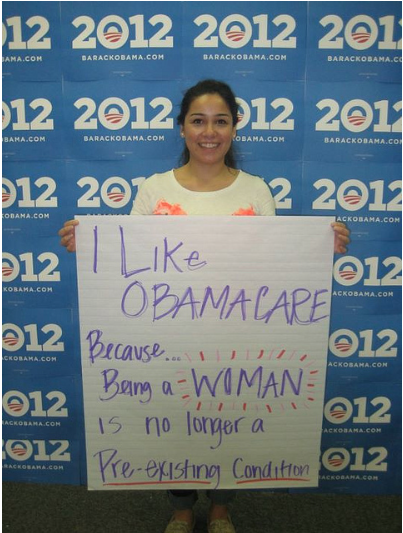
Millions of Americans, many of whom are or could be in situations similar to hers, were previously uninsured and can now have access to the healthcare that they need. People cannot be denied coverage due to their pre-existing conditions, further being a woman is no longer a “pre-existing condition” that one should have to worry about.
One of millions of women who are happy
 that their gender will not be the deciding
 factor on their access to healthcare. [21]

When looking at ObamaCare from a justice standpoint, I would agree with John Rawls. Rawls viewed justice as fairness. Rawls believes that everyone should have equal basic rights and equal opportunities. The only inequalities in opportunity need to be inequalities that are “attached to offices of positions open to all under conditions of fair equality of opportunity”[15]. Rawls also presents a difference principle, this states that “however great the inequalities in wealth and income may be, and however willing people are to work to earn their greater shares of output, existing inequalities must contribute effectively to the benefit of the least advantaged. Otherwise the inequalities are not permissible” [16]. While its true that some will have to pay a greater tax than others, this act attempts to equalize the opportunity for healthcare. Those who are benefitting are the millions of previously uninsured citizens. I feel that in my life I have taken my healthcare for granted, I am assured that I will be able to be treated every time I am sick, and I will get the medications I need. Millions of people are not so lucky, Travis Turner [17] was diagnosed with liver cancer while still an infant and quickly reached his million dollar cap. With the passing of ObamaCare, Travis was given a second chance at life.

The passing of ObamaCare is controversial, but it is providing hope for so many Americans, such as Travis, who are in dire circumstances. I support ObamaCare because I agree with Rawls that everyone should have an equal opportunity to healthcare. When looking at the people benefitting from ObamaCare truly as people and not just statistics, you could see why this act is so important and will make a positive impact on American HealthCare.


Works Cited 
[1]  Emily Smith, and Caitlin Stark. "By the numbers: Health insurance." CNN, June 28, 2012. http://www.cnn.com/2012/06/27/politics/btn-health-care/index.html (accessed November 20, 2012). 
[2] Sarah Kliff, The Washington Post, "What happens if a state opts out of Medicaid, in one chart." Last modified 2012. Accessed October 23, 2012. http://www.washingtonpost.com/blogs/ezra-klein/wp/2012/07/05/what-happens-if-a-state-opts-out-of-medicaid-in-one-chart/.
[4] Kimberly Amadeo. About.com US Economy , "useconomy.about.com." Last modified 2012. Accessed December 11, 2012. http://useconomy.about.com/od/healthcarereform/f/What-Is-Obama-Care.htm.
[5] Ibid, 2012
[6] Ibid, 2012 
[7] UpTakeVideo. "Obama's Health Plan in 4 minutes." YouTube. , September 21, 2009, http://www.youtube.com/watch?v=htZN-Is7N7o. 
   December 11, 2012
[8] Brian Koenig. Yahoo! News , "CBO: ObamaCare Price Tag Shifts from $940 Billion to $1.76 Trillion." Last modified March 14, 2012. Accessed December 11, 2012. http://news.yahoo.com/cbo-obamacare-price-tag-shifts-940-billion-1-163500655.html.
[9]Phil Galewitz. Kaiser Health News , "Consumers Guide to Health Reform." Last modified 2010. Accessed October 23, 2012. http://www.kaiserhealthnews.org/Stories/2010/March/22/consumers-guide-health-reform.aspx

[10] Jenny Gold . Kaiser Health News , "'Cadillac' Insurance Plans Explained." Last modified March 18, 2010. Accessed December 11, 2012. http://www.kaiserhealthnews.org/stories/2010/march/18/cadillac-tax-explainer-update.aspx.

[11] Galewitz, Phil. Kaiser Health News , "Consumers Guide to Health Reform." Last modified 2010. Accessed October 23, 2012. http://www.kaiserhealthnews.org/Stories/2010/March/22/consumers-guide-health-reform.aspx
[12] Robert Nozick, "Anarchy, State, and Utopia," Justice:A Reader, ed. Michael J. Sandel (New York: Oxford University Press, 2007), 60, 61
[13] Board, Editorial. The Washington Post, "Why the individual mandate holds the key to health-care reform." Last modified 2012. Accessed October 23, 2012. http://www.washingtonpost.com/opinions/why-the-individual-mandate-matters-so-much/2012/03/23/gIQA8zCacS_story.html.
[14] KFFHealthReform. "Health Reform Explained Video: "Health Reform Hits Main Street"" YouTube. , September 17, 2010,http://www.youtube.com/watch?v=3-Ilc5xK2_E.  December 11, 2012
[15]John Rawls, Justice as Fairness: A Restatement, (Cambridge, MA: The Belknap Press of Harvard University Press, 2001), 42,61,64.

[16] Ibid, 2001
[17] Steelworkers. "Affordable Care Act: Hope Delivered for USW Families" YouTube. , September 9, 2012, http://www.youtube.com/watch?v=a8SiheO7XlQ. December 11, 2012
[18] Photo, http://obamacarefacts.com/obamacarefacts-images/obamacare-cartoon-2-a.jpg
[19] Photo,http://www.washingtonpost.com/blogs/wonkblog/wp/2012/08/30/how-congress-paid-for-obamacare-in-two-charts/
[20] Photo,http://cdn.front.moveon.org/wp-content/uploads/2012/01/obamacare-500.png
[21] Photo, http://media-cache0.pinterest.com/upload/133278470192807562_IsxiExg6_c.jpg